
MATE preserves the GNOME 2 workflow, but it is not frozen GNOME 2 code. The desktop now uses GTK 3, Marco maintains Metacity-compatible decorations, and Wayland support is arriving component by component. Its theme model remains pleasantly legible: widgets, window borders, icons, cursors and panel layout are separate things.
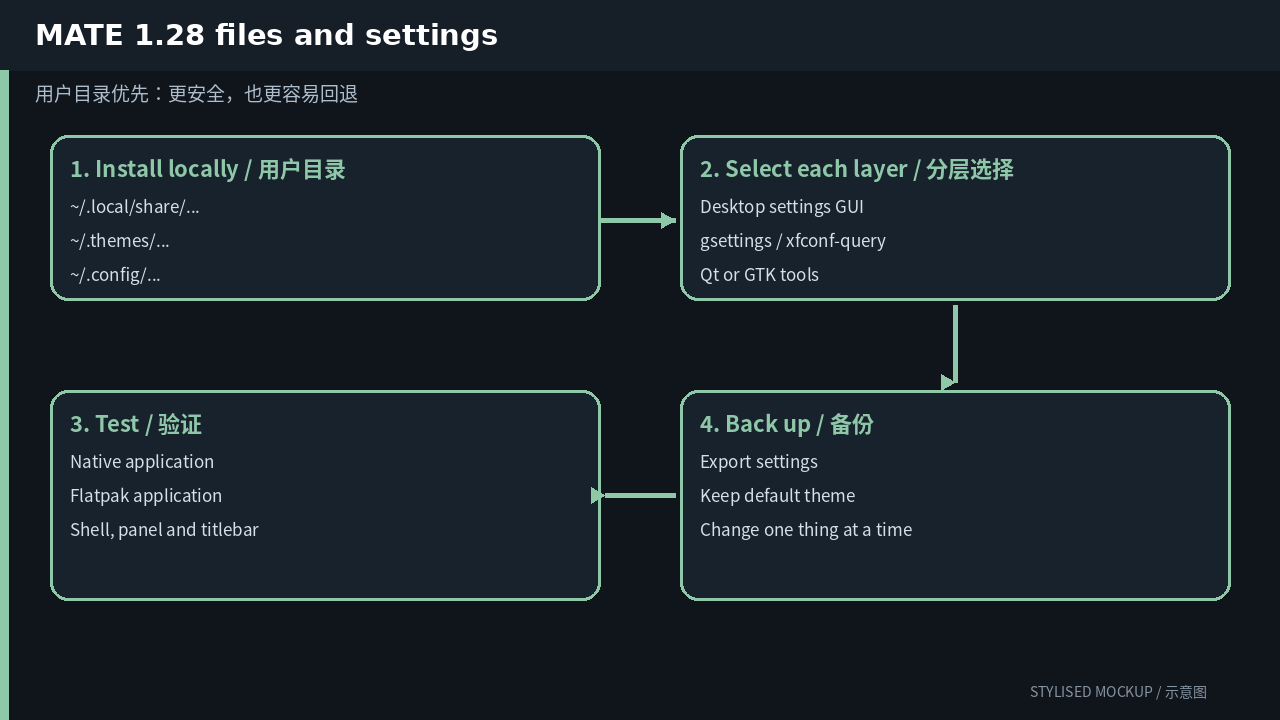
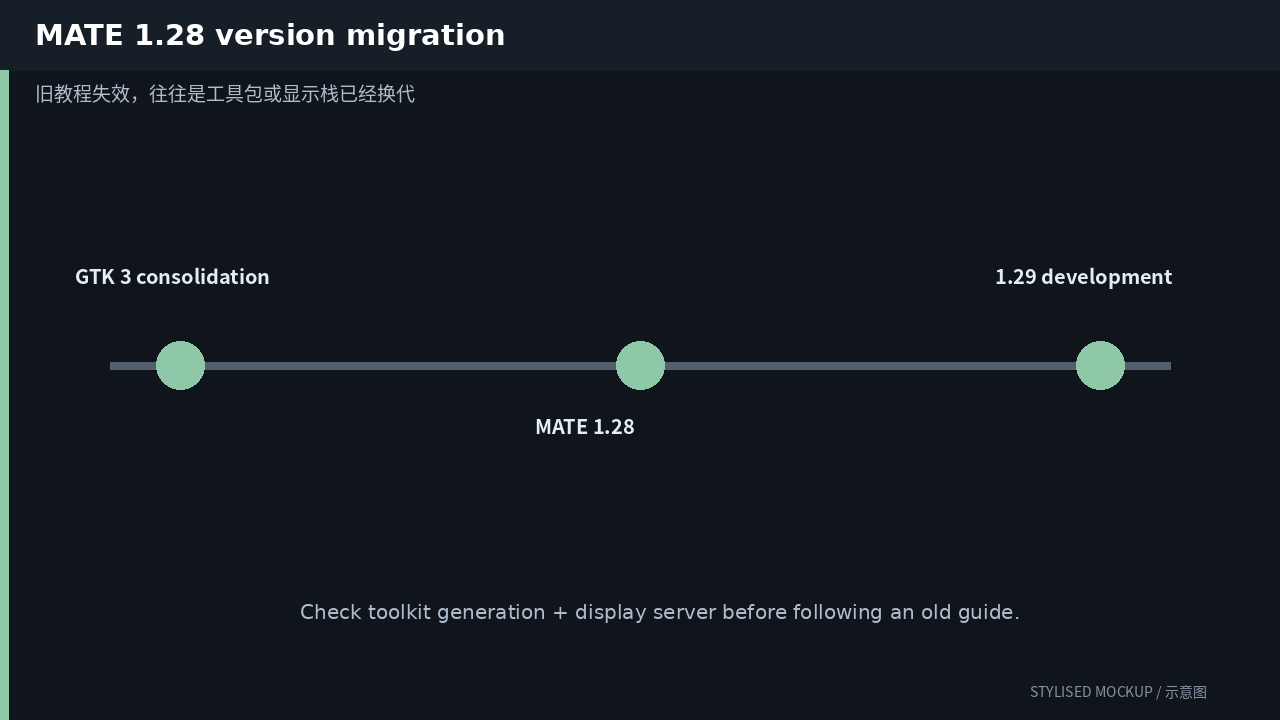
The three diagrams in this article are documentation-based illustrations, not desktop screenshots. Official screenshot assets could not be fetched reliably while preparing the article, so every image is explicitly marked “STYLISED MOCKUP / 示意图”.
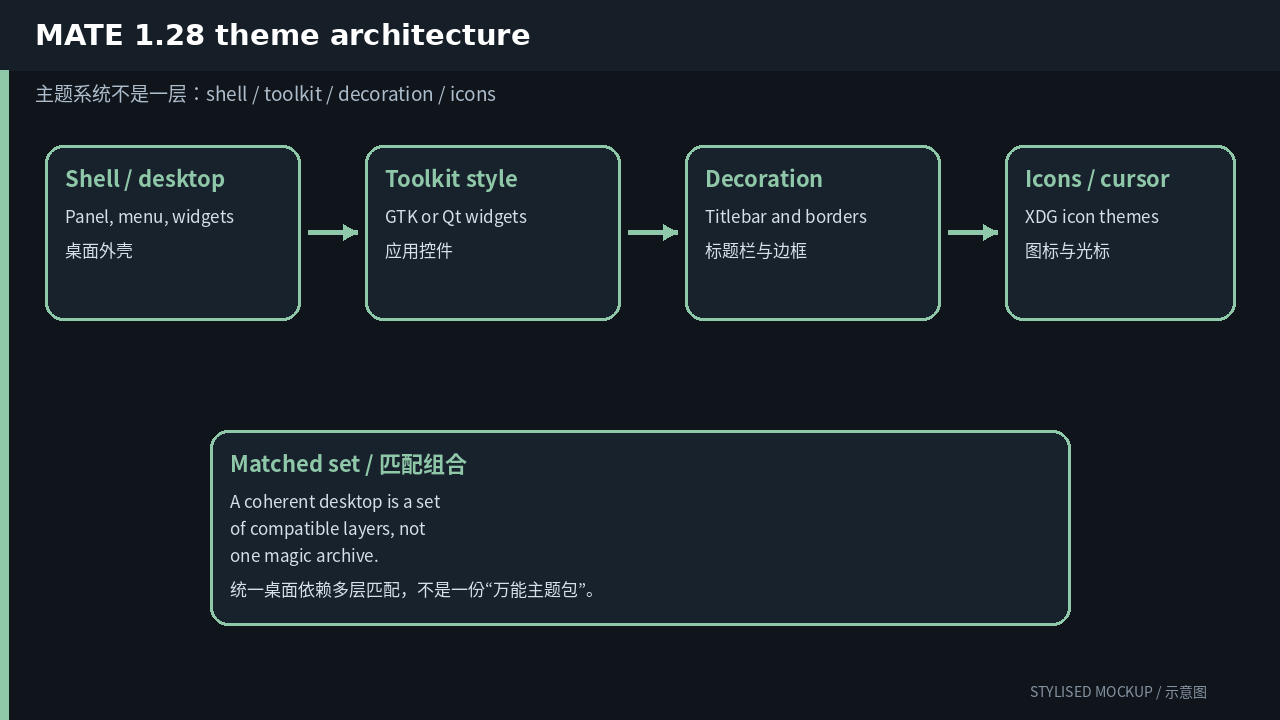
First question: which layer are you changing?
| Layer | What it controls | User path / entry |
|---|---|---|
| GTK controls | Buttons, menus, panels inside applications | ~/.themes/<name>/gtk-3.0/ |
| Marco decoration | Titlebars, borders and window buttons | ~/.themes/<name>/metacity-1/ |
| Icons and cursors | Freedesktop icon and Xcursor themes | ~/.local/share/icons/ |
| Panel layout | Panels, applets and their placement | dconf under /org/mate/panel/ |
| Wallpaper | Caja desktop background | org.mate.background |
| Fonts | Interface, document, monospace and titlebar fonts | org.mate.interface and Marco settings |
When a newly installed theme changes only half the desktop, that is usually not a bug. It means you installed one layer. Icons, window decorations, application controls and the desktop shell commonly have different owners.
A customization order that is easy to undo
- Open Control Center → Appearance and choose the widget theme, colors, icons, pointer and fonts. Window-border selection is part of the same appearance dialog on most distributions.
- A complete MATE theme normally carries gtk-3.0 and metacity-1. GTK themes made for Xfce or Cinnamon often style the widgets, but they may not include a Marco border.
- Use MATE Tweak when you want a different panel workflow such as Redmond, Cupertino or Mutiny. That changes layout, not the GTK artwork.
- Export /org/mate/ with dconf before changing panel layouts. A layout preset can remove or replace existing applets.
- Use marco-theme-viewer while editing Metacity XML. It catches missing frame pieces without risking your active desktop.
Inspect and switch settings from the terminal
The GUI is good for discovery; commands are good for repeatability. The examples below affect only the current user. Confirm that every theme name exists locally before applying it.
# apply the visual layers
gsettings set org.mate.interface gtk-theme 'Menta'
gsettings set org.mate.interface icon-theme 'Papirus'
gsettings set org.mate.Marco.general theme 'Menta'
gsettings set org.mate.peripherals-mouse cursor-theme 'DMZ-Black'

# back up the desktop and restore it later
dconf dump /org/mate/ > mate-profile.ini
# dconf load /org/mate/ < mate-profile.ini
Do not begin by copying everything into a system directory with sudo. A user-local install is easier to remove and will not leave unmanaged files mixed into distribution packages.
If you are editing a theme, change one thing first
Copy an existing theme into the user directory and give it a new internal name. Do not edit the distribution copy under /usr/share. For the first pass, change one color, one spacing value or one icon group. Once the loader path and cache behavior are proven, widen the edit.
If the package has metadata or an index.theme, update its internal name as well. Renaming only the directory can create two identically named entries and leave inheritance pointing at the original package.
Version changes: why old guides fail
| Version | Theme-relevant change |
|---|---|
| MATE 1.20–1.26 | The long GTK 3 consolidation period. Themes relying on obsolete GTK 2 engines became less useful, while Metacity-compatible decorations stayed stable. |
| MATE 1.28 | The current stable line modernizes build systems and improves Wayland readiness across Caja, Control Center, panel applets and other components. X11 remains the dependable complete session. |
| MATE 1.29 development | The development line adds more window and display behavior changes on the road to the next stable series. Do not treat a component tagged 1.29 as the normal distro baseline yet. |
A path from an old guide may still exist while the theme engine, toolkit generation or display server has changed underneath it. Before following a recipe, identify whether it targets GTK 2/3/4, Qt 5/6, X11 or Wayland, then check its date.
Common failure modes
- Panel layouts are not themes. Applying a MATE Tweak preset can move or remove applets even when the colors do not change.
- GTK 2-only themes are historical artifacts on a current MATE installation.
- Marco decorations use Metacity theme files; a GTK theme alone does not guarantee matching titlebars.
- Wayland sessions may use different decoration and panel paths. Theme on X11 first if you need the full traditional MATE feature set today.
A sensible end state
Tune the default theme until it is comfortable, then replace one third-party component at a time. A complete makeover is satisfying, but it makes readability, scaling and Flatpak mismatches harder to diagnose. The durable setup is often conservative: keep the desktop’s default widget style and change colors, icons, cursors and window decoration around it.
More desktop theming guides
- KDE Plasma theming guide
- GNOME theming guide
- Xfce theming guide
- Cinnamon theming guide
- LXQt theming guide
Comments