
Rocky Linux 10.3 became generally available on November 16, 2026, and it is the most consequential Rocky release since the 10.0 series launched. Two things stand out immediately: the platform now ships production-grade post-quantum cryptography across SSH, IPsec, TLS, audit and OpenPGP, and it raises the hardware floor to the x86-64-v3 microarchitecture, which permanently excludes a slice of older x86-64 hardware that Rocky 9 still supports.
If you run Rocky in production, this release is mostly a routine dnf -y upgrade. If you are evaluating it for the first time, the baseline change is the thing to read twice before you commit.
Official downloads are at rockylinux.org/download.
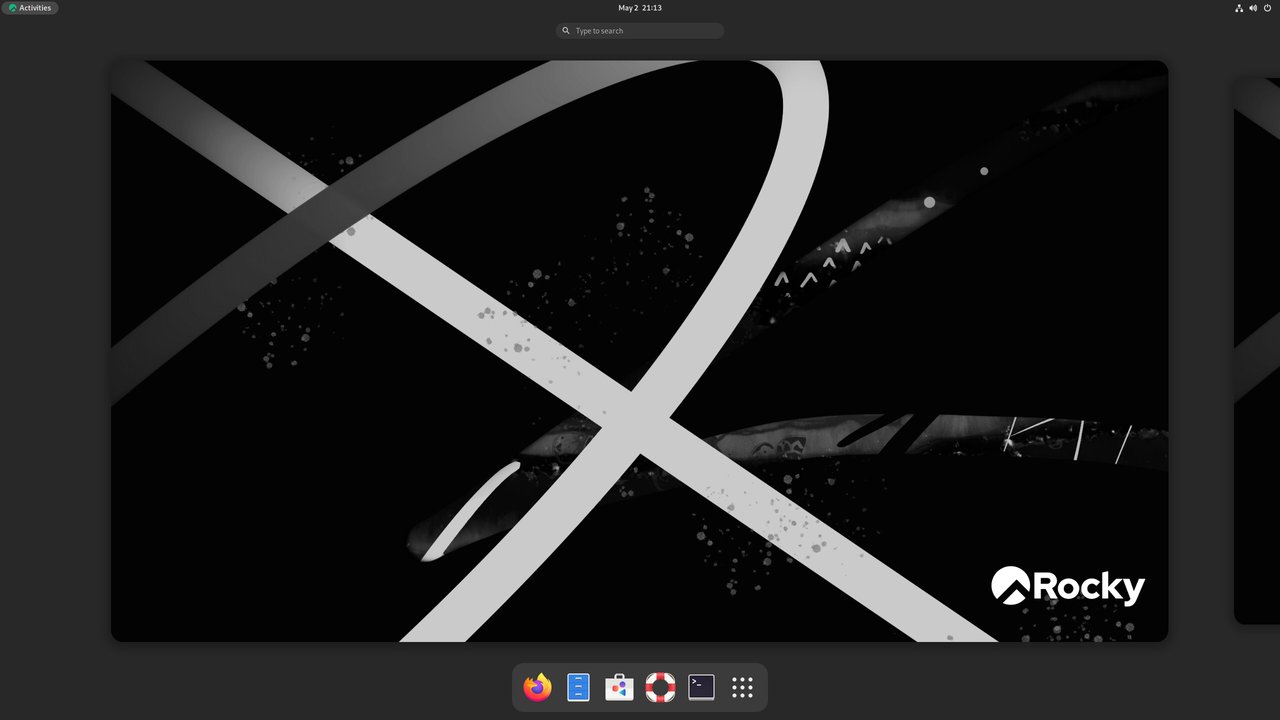
Figure: The official Rocky Linux homepage hero image, from rockylinux.org.
What Rocky Linux 10.3 actually is
Rocky Linux is a community-run enterprise operating system that rebuilds its sources directly from Red Hat Enterprise Linux, aiming for bug-for-bug compatibility with RHEL. It is a registered Digital Public Good, is governed by the Rocky Enterprise Software Foundation, and follows a ten-year support lifecycle.
Three release lines are live in parallel right now:
| Release | Upstream reference | Planned end of life |
|---|---|---|
| 10.3 | RHEL 10.3 / 9.9 | May 31, 2035 |
| 9.9 | RHEL 9.9 | May 31, 2032 |
| 8.10 | RHEL 8.10 | May 31, 2029 |
Rocky 9.9 reached general availability a day earlier, on November 15, 2026, so both the 10.x and 9.x lines were refreshed in the same week.
The hardware baseline is the headline change
Rocky Linux 10 requires the x86-64-v3 microarchitecture level on 64-bit AMD and Intel systems. Hardware at x86-64-v2 or earlier is not supported. Practically, that means the CPU must support AVX2, BMI1/BMI2, FMA and MOVBE — instruction sets that arrived with AMD Excavator/Zen and Intel Haswell.
This is the single decision most likely to affect your upgrade planning. If you have desktops or servers built before roughly 2013, they will run Rocky 9.9 until its 2032 end of life, but they cannot run Rocky 10.
Rocky ships a CPU compatibility check procedure so you can check a machine before you attempt an install. Do that first on any fleet you have not refreshed since 2023.
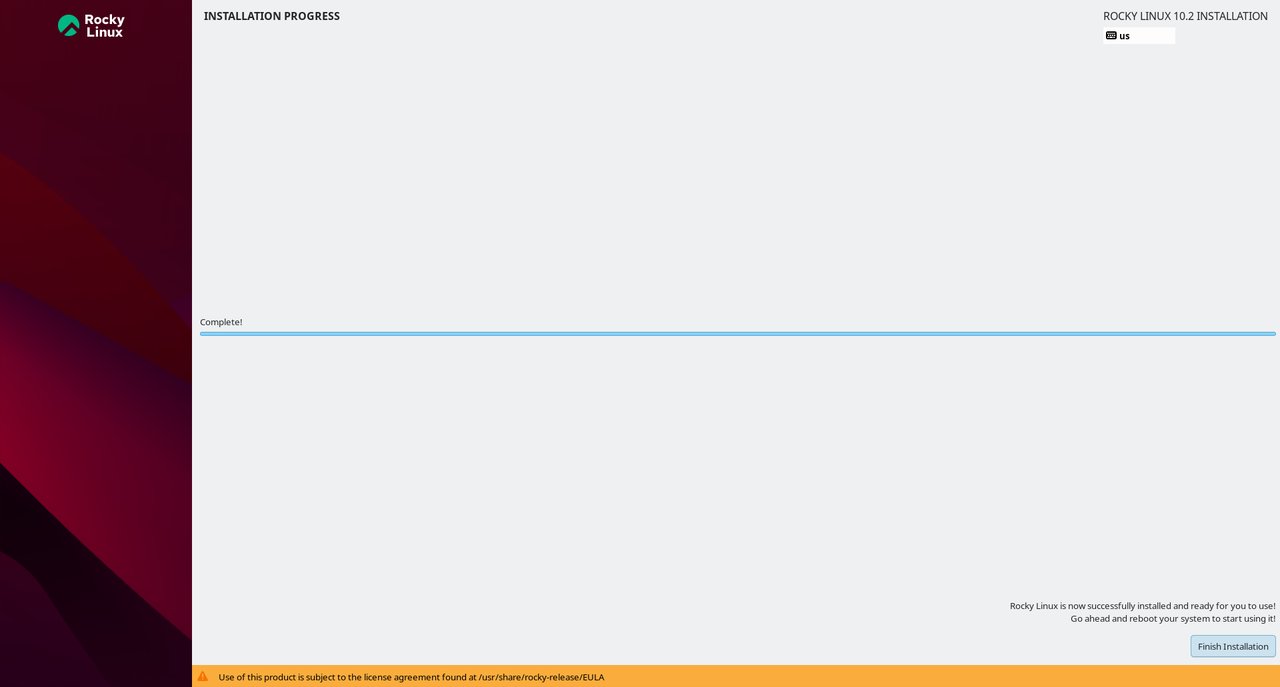
Figure: The Anaconda installer used across the Rocky 10 series, from the official Rocky Linux documentation repository.
Supported architectures for 10.3 are x86-64-v3, aarch64, riscv64, ppc64le (POWER10 and later) and s390x (IBM z15 and later).
Post-quantum cryptography is the headline feature
This is where 10.3 separates itself from every previous Rocky release. The release notes devote an entire section to it, and the changes are real rather than cosmetic:
- SSH in FIPS mode now supports and prefers hybrid post-quantum key exchange —
mlkem768nistp256-sha256andmlkem1024nistp384-sha384. These combine classical elliptic-curve agreement with ML-KEM, so they stay safe if the quantum part is broken and if it is not. - Libreswan 5.4 adds ML-KEM-768 and ML-KEM-1024 key exchange in IKEv2, plus multiple key exchanges per RFC 9370.
- audit 4.2.1 adds TLS 1.3 with post-quantum cryptography and PSK authentication for remote logging.
- rust-sequoia-sqv 1.5.0 provides full post-quantum OpenPGP support based on the final RFC 9980.
- OpenSC 0.27.1 adds PKCS #11 version 3.2 support and post-quantum cryptography features.
- Go 1.27.3 ships
crypto/mldsa, implementing the post-quantum ML-DSA signature scheme.
For most administrators the practical effect is nil today. For anyone building infrastructure with a fifteen-to-twenty-year horizon — utilities, telecom, defence supply chains, anything under a long compliance mandate — having the primitives already in the base image removes a migration that would otherwise be painful.
Kernel: eBPF rebased to 6.19
The Rocky 10.3 kernel is 6.12.0-264.16.1. The notable kernel work is not the base version but the rebase of the eBPF subsystem and perf to upstream 6.19, which pulls in a large batch of BPF functionality that Rocky 9 users have not had.
Also in this release:
- Runtime Verification monitors are enabled, including
schedandrtapp. rtlagains custom eBPF threshold-overflow actions and clearertimerlatstack analysis for EFI call paths.- Integrity Measurement Architecture (IMA) appraisal is tightened on previously unevaluated filesystems.
tbootis updated for Intel Trusted Execution Technology workflows.- Intel Resource Director Technology support expands through an
intel-cmt-catrebase, with related QAT and IAA userspace updates. - IBM Z tooling and cryptography packages are refreshed, including
libzpcversion 2. - Memory management and CXL enablement continues for Grace and special-purpose memory configurations.
- The AMD
amdxdnadriver for Neural Processing Units ships as a Technology Preview.
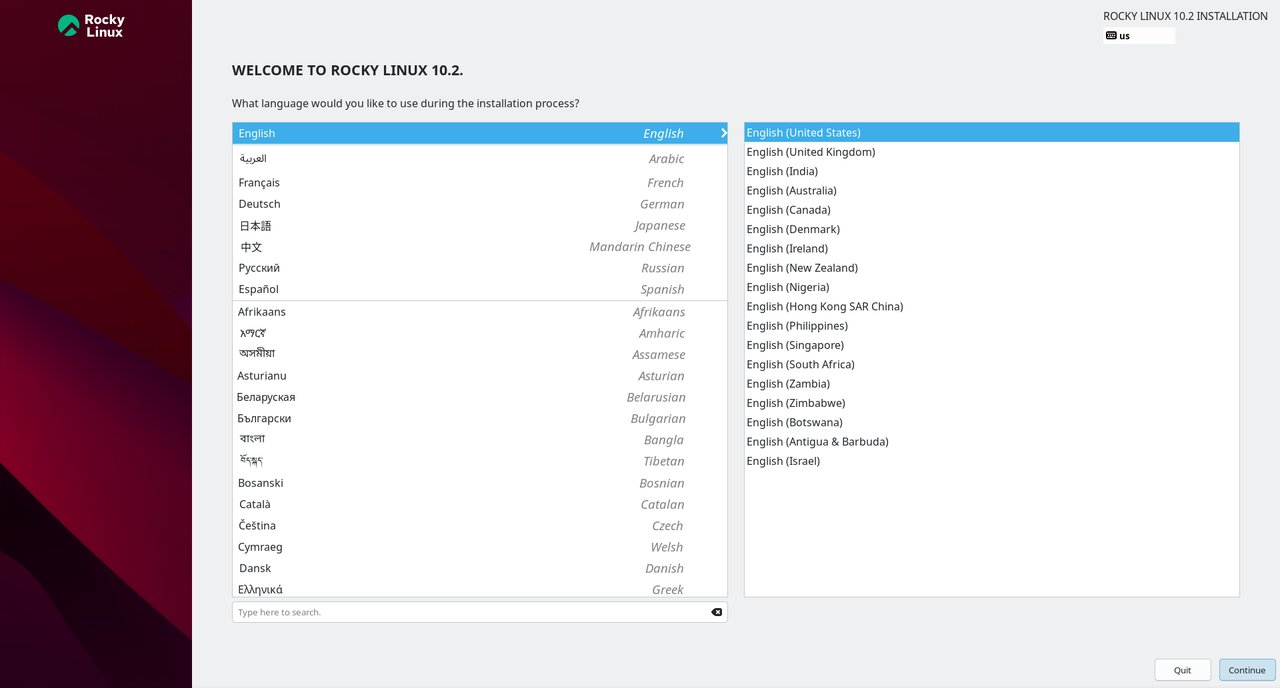
Figure: Language selection in the Rocky 10 series installer, from the official Rocky Linux documentation repository.
Compilers and developer tooling move forward
The developer story is the quiet one that pays off over years:
- GCC Toolset 16 provides GCC 16.2 and Binutils 2.46 as Application Streams alongside the system compiler, adding C++26 features including Reflection and Contracts, and changing the default C++ standard to
-std=gnu++20. - The LLVM toolset moves from version 21 to 22.1.8.
- Rust 1.97 applies upstream changes from Rust 1.93 through 1.97 and switches to the v0 symbol mangling format for more accurate generic-type demangling.
- GDB 17.2 supports debugging x86-64 CET shadow stacks and AArch64 Guarded Control Stacks.
- Grafana 12.4.3 introduces a redesigned dashboard architecture built on the Scenes library, a
Recoveringalerting state for flapping alerts, and drops legacy alerting and AngularJS plugins. - PCP 7.1.5 adds automatic archive repair in
pmlogcheck, new metrics for Linux delay accounting and Device Mapper multipath monitoring, and improved handling of corrupted archives. - The Grafana PCP plugin 6.1.0 supports Grafana 12 and ships prebuilt dashboards for NVIDIA GPU metrics and vLLM inference server performance.
The image-builder CLI is now generally available, letting you build OS artifacts and image-mode assets directly from a terminal.
Other changes worth knowing
Identity management saw several additions: ipauser and ipagroup in the ansible-freeipa package gained a query state that retrieves IdM users and groups without modifying them; Active Directory AMA SIDs can be mapped to authentication indicators using pam_gssapi_indicators_apply; and numerical UIDs and GIDs in access.conf can now bypass name resolution to speed up access checks.
On the infrastructure side, RDMA support is now available for Valkey, which matters if you run Valkey as a cache in a low-latency fabric.
fapolicyd 2.0.1 brings multi-threaded parallel decision processing, transactional policy and trust database updates, dynamic database sizing and systemd watchdog integration. crypto-policies gained a NO-HMAC-SHA1 subpolicy for compliance scanners. aide now ships a pre-configured aide-check.timer systemd unit for automated integrity checks, with drop-in configuration in /etc/aide.d. libcap-ng 0.9.3 adds a cap-audit tool for inspecting application capability requirements plus an advanced attack-surface option in netcap.

Figure: The Rocky Linux 10 desktop with the default Gemstone Skies wallpaper, from the official Rocky Linux documentation repository.
Upgrading from Rocky 10.x
The procedure is short because Rocky does not support cross-major upgrades. From any 10.x release:
dnf -y upgradeMoving from 8.x or 9.x to 10.x requires a fresh installation and a restore from backup. There is no in-place path.
FreeIPA servers need one extra step. Switching tomcat versions before the upgrade is required:
dnf swap tomcat9 tomcat --allowerasing
dnf update
Raspberry Pi images are not ready. The Rocky testing team found issues with the Raspberry Pi images and expects to ship updated ones soon. If you deploy Rocky on Pi hardware, stay on your current image for now.
Getting the images
For x86_64, Rocky 10.3 publishes a DVD ISO, a smaller Boot ISO and a Minimal ISO, each with a matching checksum file and a torrent for the DVD. Generic Cloud QCOW2 images are published for cloud deployment, and Docker Hub carries official Full and Minimal OCI images under the rockylinux/rockylinux repository.
# Verify what you downloaded before you boot it
sha256sum -c CHECKSUM
Rocky also publishes live images for desktops and WSL images for Windows hosts, alongside listings on AWS, Google Cloud Marketplace and Microsoft Azure Marketplace.
Who should adopt 10.3, and who should wait
Adopt now if you run Rocky 10 already, if your hardware is v3-class or newer, or if post-quantum readiness is on your compliance radar. The SSH, IPsec and TLS changes are the kind that are far cheaper to adopt now than in five years.
Wait if you run pre-2013 x86-64 hardware and depend on Rocky 9 features — stay on the 9.9 line, which is supported until May 2032. Also wait if you deploy Raspberry Pi images, and read the upstream known-issues list before a large rollout, since Rocky explicitly flags that some Application Streams will no longer receive updates.
For an enterprise distribution whose entire value proposition is stability, Rocky 10.3 is exactly what it should be: no re-branding, no gratuitous churn, and a meaningful long-term security upgrade underneath.

Figure: The official Gemstone Skies daytime wallpaper shipped with Rocky Linux 10, from the rocky-linux/rocky-logos repository.
Comments