
Melvor Idle 2 on Linux: Native Day One, English Only
On 17 November 2026, Games by Malcs released Melvor Idle 2: A RuneScape Adventure into Steam Early Access — with Jagex, the company behind RuneScape, on the publishing credits. For Linux players the headline is genuinely good: the sequel ships with a native Linux build on day one. No Proton, no Wine, no compatibility layer to babysit.
But the same launch that makes it effortless to run also makes it awkward for a large slice of the audience. Melvor Idle 2 ships in English only. For a game whose entire branding is now “A RuneScape Adventure”, that is not a minor footnote — it is the loudest complaint in the launch reviews, and it lands especially hard on the Chinese, Japanese, Korean and Russian players who were used to a much more internationally-minded predecessor.
Here is what actually launched, what it means for Linux specifically, and where the rough edges are.

Figure: Official library hero art from the Steam store listing.
What actually shipped on 17 November
Early Access launches are rarely the finished article, and this one is no exception. The build that went live on 17 November contains:
- 25 skills — 8 combat and 17 non-combat — each capped at level 99.
- 1,138 new items, 121 new enemies, and Act 2 of the story.
- Five genuinely new skills were promised. Three are in the launch build: Ranching, Hunting and Beastcrafting. Construction and Enchantment sit on the pre-1.0 roadmap.
- Three returning skills were reworked: Astrology, Herblore and Agility.
- A reimagined Mastery system with Master Guilds, a new Quest system, melee/ranged/magic combat, dungeons, bosses, offline progression, a dynamic day/night cycle, a weather system, and support for user-created mods built into the design.
One clarification worth making, because the marketing numbers disagree with the shipping build: the 29 skills and level 120 cap belong to the full-release roadmap, not to Early Access. The Steam store page lists 25 skills capped at level 99 for what you can play today; the extra four skills and levels 100–120 are still to come.
Price at the time of writing is $14.99 USD, with a 10% launch discount taking it to $13.49 until 24 November 2026. A soundtrack DLC is also listed at $4.99.
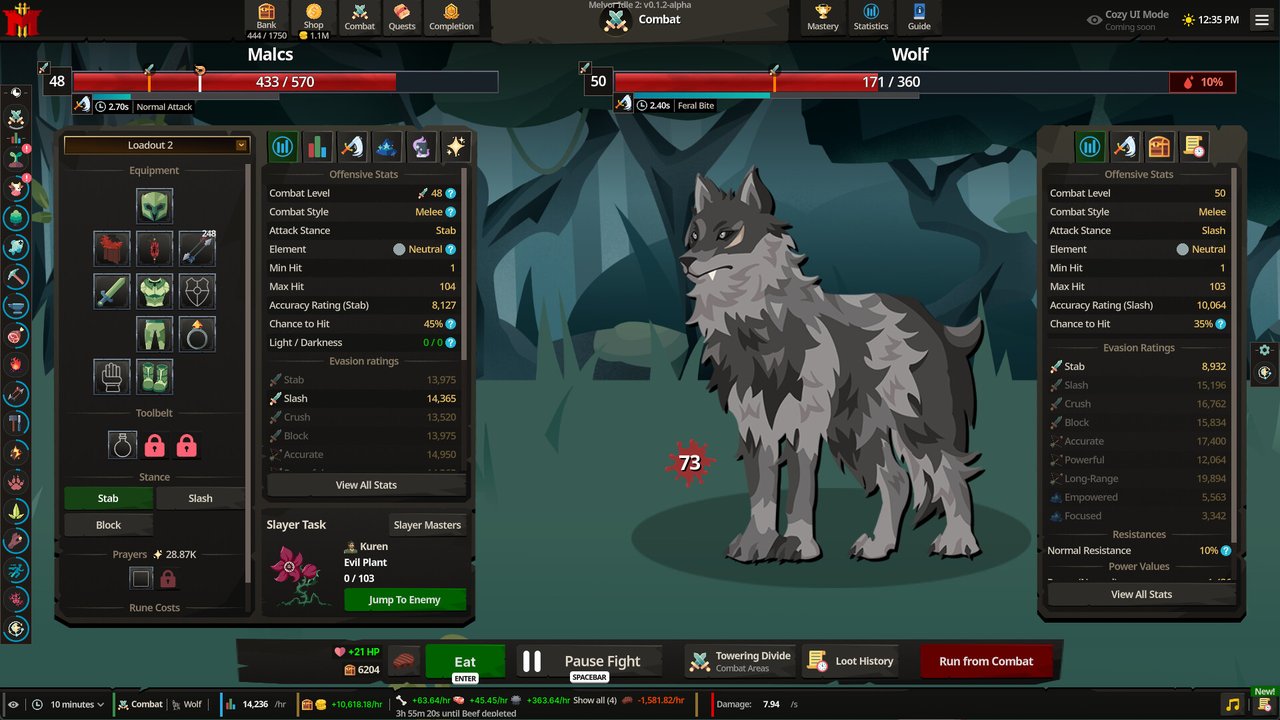
Figure: The combat screen, from the official Steam listing screenshots. Equipment slots, offensive stats and evasion ratings all sit on one panel.
The Linux story: native, and it actually matters
The store page lists Windows, macOS, SteamOS and Linux as supported platforms, and the build Steam ships to Linux is the native one. There is no compatibility layer involved.
The technical details explain why. SteamDB lists the game as 64-bit, built on the Godot Engine, with the .NET SDK, Nakama SDK and SteamworksNET SDK in the dependency list. In other words, Melvor Idle 2 is a native C# application, not a Windows binary being translated at runtime.
That matters because of where the series came from. The original Melvor Idle was an HTML5/TypeScript browser game — you played it in a tab, which is exactly why it became a fixture on so many Linux desktops and why its community is unusually price- and platform-sensitive. The sequel moves to C# and Godot, which is a heavier runtime but a much better foundation for combat, dungeons and mods.
Practically, the install is: open Steam, install the game, play. There is nothing to configure. Compare that with the current state of the wider Proton ecosystem — Valve’s Proton 11.0 line is still churning through release candidates, and GE-Proton 11-12 shipped a large batch of VKD3D and DXVK fixes in early November — and a native build that just works is a pleasant change of pace.
The Steam Deck catch: Playable, not Verified
The handheld story is the one genuine asterisk. Valve assigned Melvor Idle 2 a Playable rating on Steam Deck — tested on 9 November 2026 — rather than Verified.
The good news in SteamDB’s test summary is substantial: the default graphics configuration performs well on Deck, the game runs successfully on SteamOS, it displays Steam Deck controller glyphs, and the recommended runtime is Native with no Proton soundfonts required. In other words, performance is not the problem.
The friction is in the interface:
- Some functionality is not accessible with the default controller configuration. You may need the touchscreen, the virtual keyboard, or a community controller profile.
- Entering some text requires manually invoking the on-screen keyboard.
- Some in-game text is small and may be difficult to read.
For an idle game where you will spend real time typing — searching a bank, tagging items, naming tabs, buying loadouts — that manual keyboard invocation is the kind of thing that wears thin over a long play session. It is workable, but budget for it.
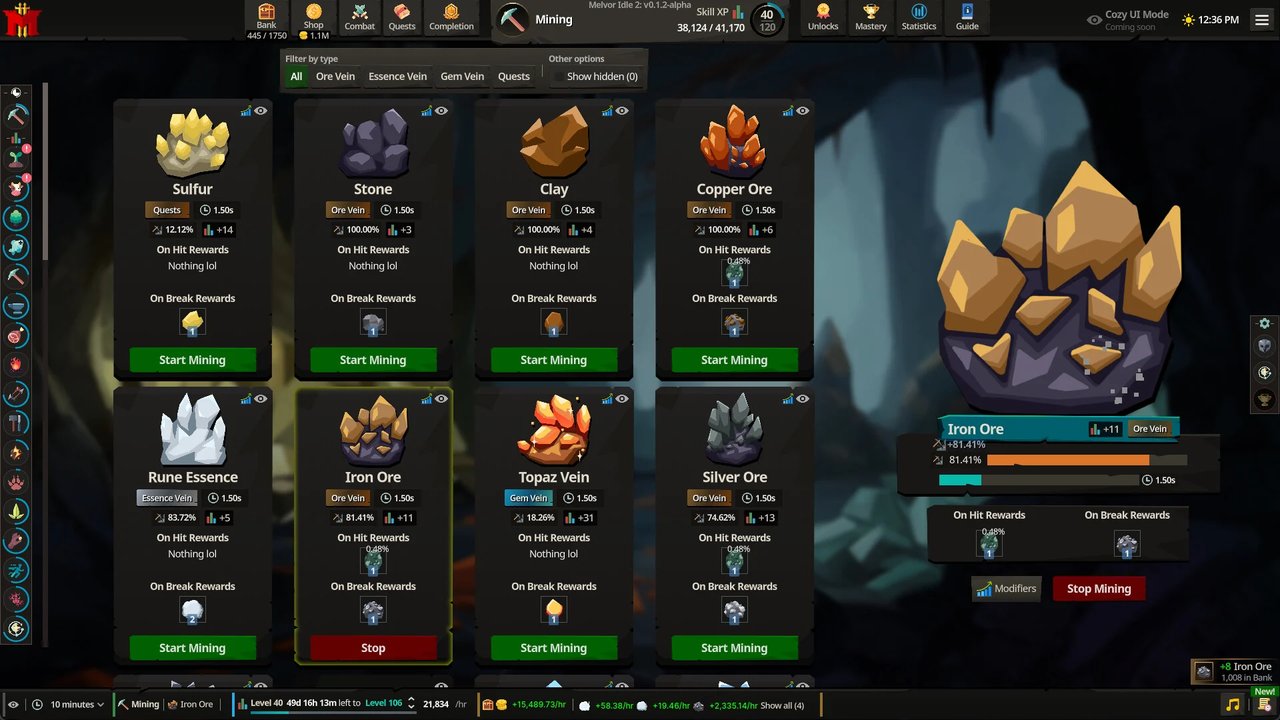
Figure: The Mining skill screen. The skill list on the left, XP-per-hour readouts along the bottom, action buttons on the right.
The bigger catch: English only
The Steam listing lists exactly one supported language: English, with full audio. Nothing else.
This is the loudest thread across the launch reviews. Players in Chinese, Russian, Korean and Japanese communities are asking for official localisation, and the absence is being read as a particular kind of betrayal — the game now carries the RuneScape name and Jagex’s publishing muscle, which sets an expectation of a global release that the single-language launch does not meet.
There is no confirmed localisation roadmap on the store page today. If you do not read English, that is currently a hard blocker on buying, and the sensible move is to wait rather than hope.
And the other big change: no browser version
This is worth spelling out, because it is the most direct consequence of the engine switch and the most common source of pre-launch disappointment.
Melvor Idle 1 was a browser game. Melvor Idle 2 is written in C# using Godot, and Godot 4 supports web export for C++ and GDScript but not for C#. As the engine stands, there is no browser build for the sequel — and the announcement discussion on GamingOnLinux made exactly this point, with long-time players openly unhappy about losing the ability to keep the original running in a background tab while they worked.
The trade-off is not as lopsided as it first appears, because offline progression in the sequel runs at the same speed as active play. The practical impact for most Linux players is smaller than the forum threads suggest — but if a background browser tab was part of your routine, that particular trick is gone.
What the reviews are saying
The store page currently shows Very Positive — around 91% of 380 reviews. SteamDB’s longer-running tracker shows 86.6% of 800 reviews with roughly 23,000 players in game at the time of writing. For a first-week Early Access launch, that is a healthy reception.
The praise is specific and consistent. Idle veterans generally call it a clear improvement over part one: a better interface, strong music, good art, and a mastery system that rewards completionists. It has become the go-to recommendation for the “AFK on top of AFK” crowd.
The complaints are equally specific:
- Several skills — Cooking, Crafting and Farming in particular — are seen as over-designed, with heavy preparation work and weaker cross-skill synergy than the original.
- The mastery grind for low-tier gear feels pointless to some reviewers.
- Farming is too expensive and ranching is boring, a notable criticism given that Ranching is one of the three headline new skills.
- No achievements and no hardcore mode yet.
- One review calls it a half-finished product at the launch price, though that appears to be the minority view.
All of this is normal Early Access friction, and the developer has been explicit that the plan is 12–18 months of Early Access to finish all planned content, with regular expansions and paid DLC that will raise the level cap.
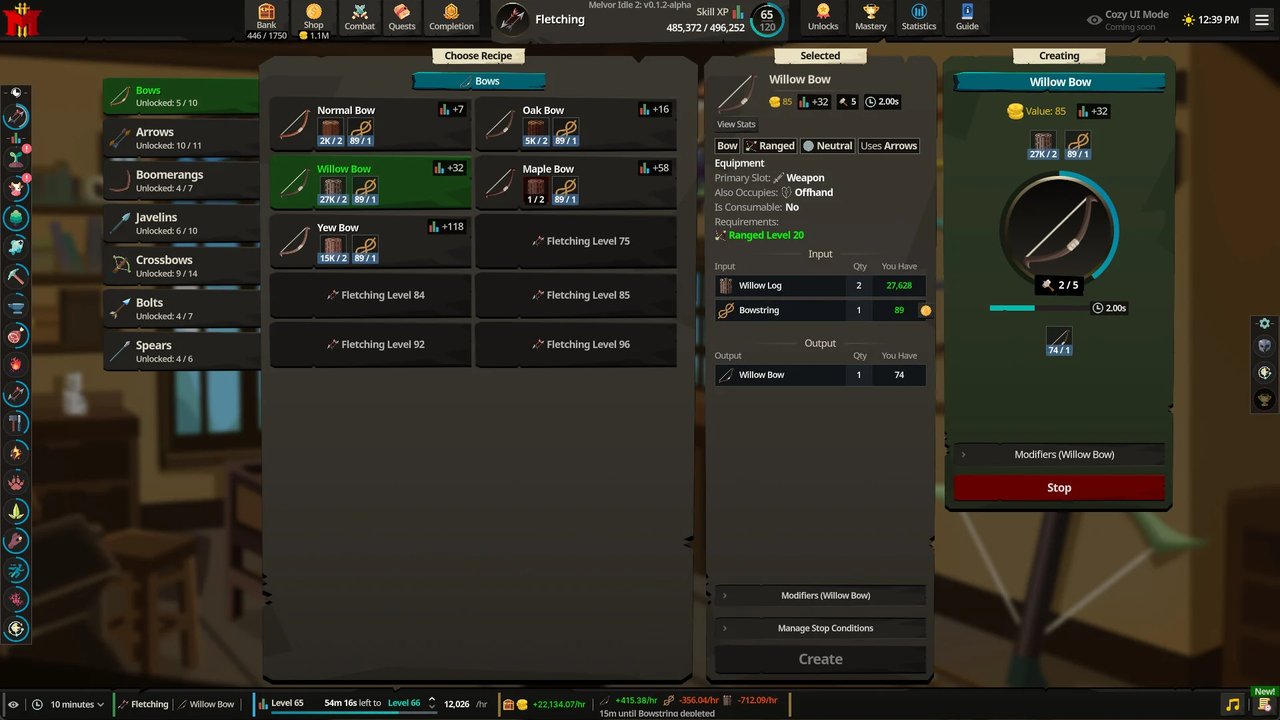
Figure: The Fletching crafting screen, showing the recipe picker, item statistics and a queue of waiting actions — one of the interfaces that makes text entry on Deck fiddly.
Running it on Linux in practice
For the record, and because it is genuinely simple:
- Install from Steam. The native Linux build is the default; nothing else is required.
- Do not install Proton or GE-Proton for this. You would be running a native game through a translation layer for no benefit.
- Expect light hardware usage. It is a 2D Godot game; it is comfortable on modest hardware and it is designed to sit idle in the background while you do something else.
- Use Steam Cloud. Saves carry across devices, and the developers have promised cross-platform cloud saving for PC and mobile once the mobile versions arrive — those are planned for 2027.
- On Steam Deck, test the on-screen keyboard early. Search and text entry are the friction points, not performance.
Verdict
For Linux players, this is close to the best-case launch scenario a sequel can have: a native, day-one, first-party-supported build of a game that a large number of Linux users first discovered in a browser tab. Jagex’s involvement also means the content pipeline is funded and the 12–18 month Early Access plan has a real roadmap behind it.
Two caveats deserve a place in your decision. Steam Deck support is Playable rather than Verified, which in practice means the on-screen keyboard and some small text. And the game is English-only, with no localisation roadmap published. Neither is a reason to skip it if you read English. Both are good reasons to wait if you do not.
Official store page: https://store.steampowered.com/app/3218350/Melvor_Idle_2_A_RuneScape_Adventure/
Comments