

Figure: AI-generated illustration. Real screenshots were unavailable at time of writing.
Headscale 0.29.7 landed on 30 October 2026 as a security release, and the
timing is not accidental. It ships the server-side fixes for the findings raised by
Anthropic’s oss-scanner project and the so-called Tailworm report that
reached Tailscale on 24 October. Four of those findings were disclosed publicly
as bulletins TS-2026-014 through TS-2026-017.
If you run a self-hosted tailnet, this is the release to plan your upgrade around.
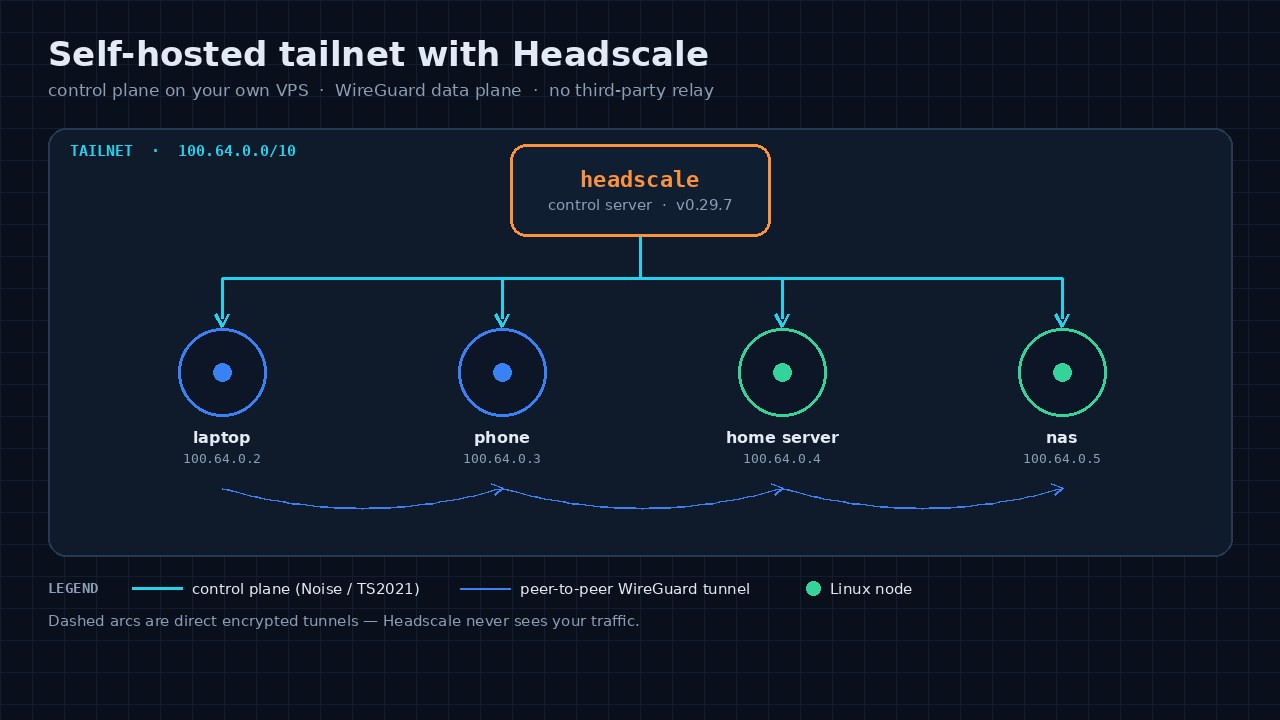
Figure: Diagram of a self-hosted Headscale tailnet — the control server handles
registration and keys, while node-to-node traffic travels over direct WireGuard
tunnels that Headscale never sees.
What Headscale actually is
Headscale is an open-source, self-hosted implementation of the Tailscale control
server. It is not a VPN client and it is not a fork of the Tailscale UI. It is
the piece that answers the question “who is allowed to join my network, and which
addresses do they get” — the coordination plane for an ordinary Tailscale client.
The distinction matters for security. In a Tailscale deployment the control plane
lives on someone else’s infrastructure, and your node keys, ACLs and node registry
are governed by a third party. With Headscale, that plane is a process you run
yourself, on a small VPS or even on a box behind your own router.
The data plane is unchanged. Headscale clients still speak the Noise protocol
(TS2021) to the server for coordination, and traffic still travels over WireGuard
tunnels established directly between peers whenever a direct path is available.
The upstream project is at headscale.net and the source
lives at github.com/juanfont/headscale —
46,000 stars, BSD-3-Clause licensed.
The October security story in full
The chain of events is worth understanding, because the fix is split across two
projects and upgrading only one of them leaves you exposed.
On Friday 23 October, concerns about Tailscale SSH began circulating publicly.
Tailscale’s engineering and security teams started investigating immediately, with
external specialists.
On Saturday 24 October, Tailscale received the researcher’s report in the
morning. The researcher published it two hours later. By then, the investigation
had already identified several related issues and work on fixes was underway.
Over the weekend through Monday 26 October, engineers reproduced the issues,
expanded the code review to address the underlying causes, implemented the fixes,
and tested them — with particular attention to Unix privilege handling and SSH
forwarding.
Tailscale’s own summary, in the Tailscale SSH: Findings and fixes
post by Mike Shaver, is precise about the severity and equally precise about what
it was not:
The vulnerabilities primarily concerned how permissions were enforced after a
connection had been authorized, rather than the authentication and access policy
checks that determine who can connect.
They don’t allow an unauthenticated attacker to connect to arbitrary Tailscale
SSH servers.
In other words: this was not a worm and not a remote unauthenticated
break-in. The accurate description is policy-limited lateral movement. An
attacker who already had a foothold on an authorised peer in your tailnet, and
whose policy file already permitted SSH, could in some conditions exceed the
permissions of the Unix user the session was configured to run as — including via
SSH forwarding.
That last clause is the technical crux. SSH servers need elevated privileges to
start a session as a different Unix user. The hard part is keeping those
server-level privileges from leaking into the connected session, where commands and
forwarding must remain inside that user’s own permissions. The findings were cases
where that boundary was not correctly enforced.
The Tailscale fixes shipped in client version 1.104.4 — they live in
tailscaled on your nodes, so upgrading Headscale alone does not apply them.
Headscale 0.29.7 is the server-side half of the same fix train, and the release
notes explicitly tell you to move both.
What Headscale 0.29.7 changed
Beyond the security work, the release carries a set of hardening changes that
matter for a self-hosted deployment.
Metrics are no longer exposed to unregistered clients. Previously, a client
that had not yet completed registration could query the metrics endpoint through
the Noise protocol. Metrics are now only reachable on the configured
metrics_listen_addr listener, and leaving that value empty disables the listener
entirely. If you were scraping metrics from an unauthenticated path, move them to a
private listener.
Pending registrations are capped rather than evicted. When the pending queue
was full, new interactive registrations could evict requests that were already
waiting for approval. That is now changed: pending registrations and OIDC logins
stay at capacity, new requests get a retry response, and registered nodes keep the
capacity they need for SSH checks. Stored pending registration data is also capped
at 64 KiB, keeping tags and expiry while rejecting oversized interactive
registrations.
The Tailscale dependency moved to v1.104.4, which also bounds how much of an
unexpected DERP HTTP response is read — a defensive limit against a misbehaving or
hostile relay.
Twelve oss-scanner findings fixed, tracked as ANT-2026-MLP8ZR5T,
ANT-2026-LYVGXVSW, ANT-2026-AWGRB7O1, ANT-2026-QMCAFJ1Q, ANT-2026-RQS7JAPP,
ANT-2026-6B6KE87K, ANT-2026-KFCFFM34, ANT-2026-K903ZEUA, ANT-2026-NM50ZP4N,
ANT-2026-ZC18AF82, ANT-2026-NWTIBB02 and ANT-2026-MX8FKG4K. None are critical,
but several cause denial of service against the Headscale process itself — which,
for a self-hosted control plane, means an unreachable tailnet.
One mitigation is worth calling out because it applies even if you cannot upgrade
the client immediately. If you use Tailscale SSH, you can disable agent and port
forwarding on a node by setting:
TS_SSH_DISABLE_FORWARDING=1in the tailscaled service environment and restarting the service. The setting
applies to all Tailscale SSH sessions on that node and is available in older
clients too.
Installing Headscale 0.29.7 on Linux
The upstream project recommends the DEB package on Debian and Ubuntu, because
it sets up the local headscale user, ships a default configuration and installs
a systemd unit. Supported distributions are Ubuntu 22.04 or newer and Debian 12 or
newer.
HEADSCALE_VERSION="0.29.7"
HEADSCALE_ARCH="amd64"
wget --output-document=headscale.deb
  "https://github.com/juanfont/headscale/releases/download/v${HEADSCALE_VERSION}/headscale_${HEADSCALE_VERSION}_linux_${HEADSCALE_ARCH}.deb"

sudo apt install ./headscale.deb
Then edit the configuration and restart:
sudo nano /etc/headscale/config.yaml
sudo systemctl restart headscale
sudo systemctl status headscale
An up-to-date example configuration is also shipped locally at
/usr/share/doc/headscale/examples/config-example.yaml.
Container images are published for the same release and are multi-arch (amd64 and
arm64):
docker run
  --name headscale
  --detach
  --read-only
  --tmpfs /tmp
  --tmpfs /var/run/headscale
  --volume "$(pwd)/config:/etc/headscale:ro"
  --volume "$(pwd)/lib:/var/lib/headscale"
  --publish 127.0.0.1:8080:8080
  docker.io/headscale/headscale:v0.29.7
  serve
The configuration that actually matters
Headscale’s config.yaml is long, but only a handful of keys need attention on a
fresh install.
server_url: "https://headscale.example.com"
listen_addr: 0.0.0.0:8080
metrics_listen_addr: ""
unix_socket: /var/run/headscale/headscale.sock
unix_socket_permission: "0770"

prefixes:
  v4: 100.64.0.0/10
  v6: fd7a:115c:a1e0::/48
  allocation: sequential
server_url is required and must be the URL clients actually reach. Keep the
prefixes inside Tailscale’s own ranges — the client assumes them and other ranges
are unsupported.
unix_socket_permission is a quoted octal string on purpose. Unquoted, YAML
reads 0770 as the number 504, which is not what you want.
trusted_proxies deserves attention: it lists the CIDRs of reverse proxies whose
True-Client-IP, X-Real-IP and X-Forwarded-For headers are honoured. Leave
it empty and those headers are ignored. Set it without actually running a proxy
in front and clients can spoof their source IP in logs and in the v2 API.
Creating a user and registering a node
Headscale organises nodes under users. Create one, then hand the node a
registration command:
sudo headscale users create alice
sudo headscale nodes register --user alice
The register command prints a tailscale up line for you to run on the client
machine. It points at your server URL, not Tailscale’s — that single fact is the
whole point of running Headscale.
Manage the CLI through the unix socket, which is readable by the headscale user,
by root, or by anyone you add to the headscale group:
sudo headscale users list
sudo headscale nodes list
Verify the server is reachable from outside by checking the health endpoint:
https://headscale.example.com/healthThe version floor you must respect
0.29.7 declares a minimum supported Tailscale client version of v1.80.0. Current
clients are well past that — Tailscale v1.104.7 was released on 12 November 2026,
and the fixes you actually want landed in v1.104.4. On the client side, make
sure tailscaled is at 1.104.4 or newer.
Managing it visually
Headscale deliberately ships no built-in web interface. The CLI is the
supported path, but several community frontends exist, and the most complete is
Headplane — a Tailscale-inspired admin UI for Headscale with roughly 3,300
stars and active development as of November 2026.
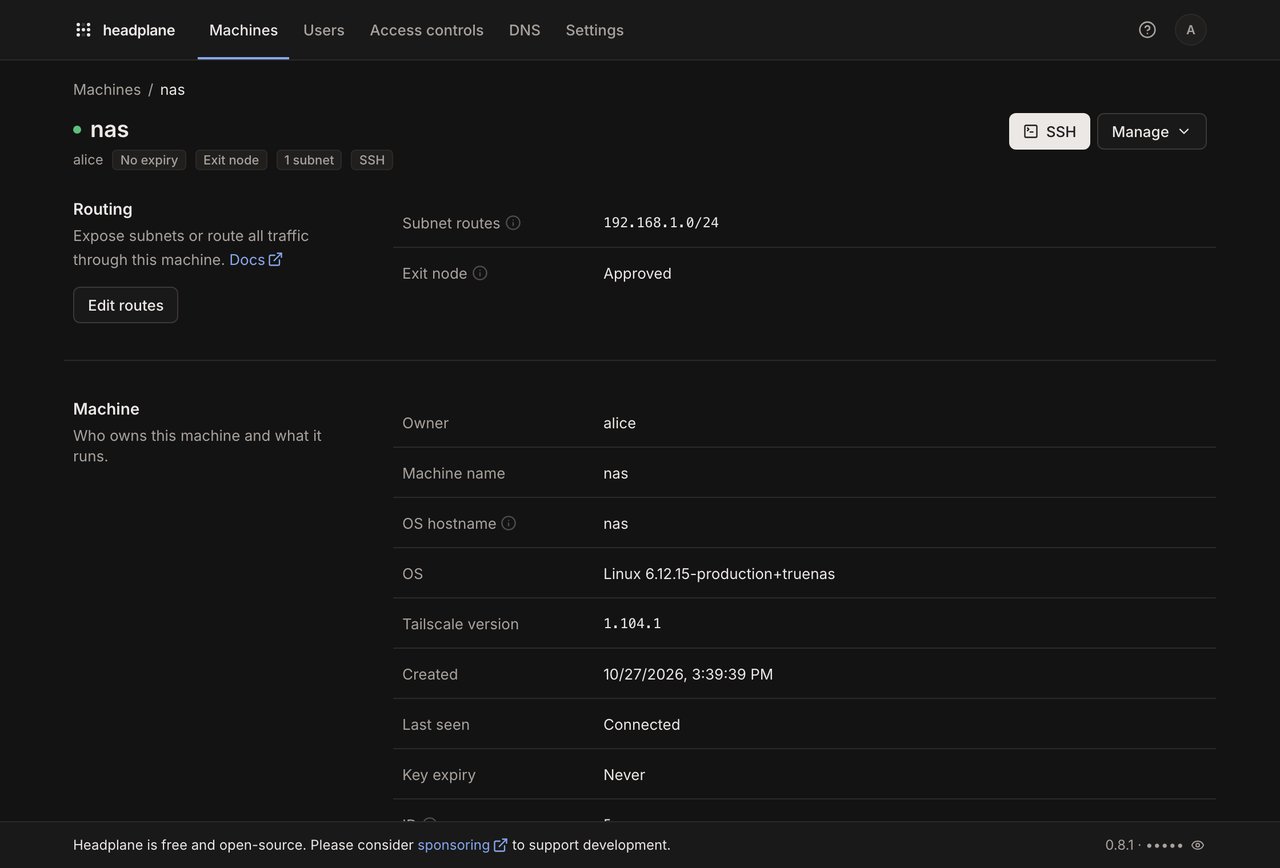
Figure: The Headplane web UI listing the machines registered in a Headscale
tailnet — a community project, not a Headscale official screenshot.
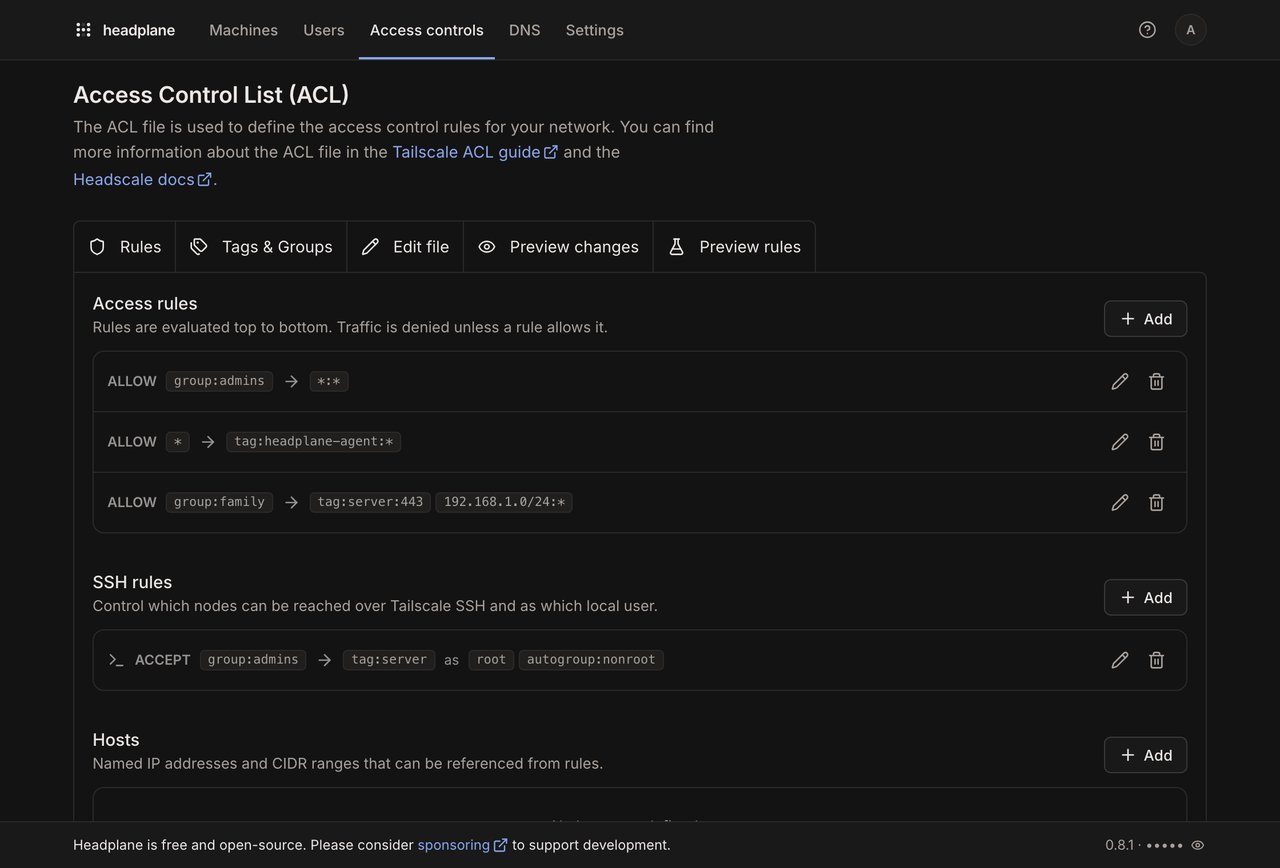
Figure: The ACL and policy view in Headplane, where you can review who is
allowed to reach which node. Community project, not an official Headscale
screenshot.
Other community options in the upstream documentation include headscale-ui,
headscale-admin, ouroboros and headscale-console. Because these are
third-party projects that talk to the Headscale API with your admin credentials,
treat them with the same care as any other client of your control plane.
Figure: Official Headscale social card from the project’s documentation site —
the upstream Headscale project card.
The upgrade checklist
If you already run Headscale, this is the order of operations.
- Read the release notes for 0.29.7 and note the minimum client version
(v1.80.0) — every node in your tailnet needs to clear it. - Upgrade your Tailscale clients first, to v1.104.4 or newer. The SSH
and forwarding fixes live intailscaled, not in the server, so a server-only
upgrade leaves the actual exploitable path open. - Upgrade Headscale to 0.29.7, then
sudo systemctl restart headscale. - If you use Tailscale SSH, set
TS_SSH_DISABLE_FORWARDING=1in the
tailscaledservice environment on each node as a belt-and-braces measure, and
restart the service. - Check your metrics exposure. If you have a
metrics_listen_addr, make sure
it is bound to a private address and not publicly reachable. An empty value
disables the listener. - Confirm your pending registration behaviour has not changed in a way that
surprises you: pending requests are no longer evicted when the queue is full. - Verify from a node, not from the server:
tailscale statuson a client
should list your peers, andtailscale ipshould return an address inside
100.64.0.0/10.
The bottom line
Headscale remains the most practical way to run a Tailscale-compatible tailnet
without handing your network registry to a third party. The October advisory
cycle was a real scare, but the honest reading is more reassuring than the
headlines: the bugs were in privilege enforcement after authentication, they
required an existing foothold on an already-authorised peer, and they were
lateral movement bounded by your own policy file.
What the episode did produce is a better release. 0.29.7 closes twelve scanner
findings, closes the metrics exposure to unregistered clients, makes pending
registration handling fair rather than evicting, and pins a Tailscale dependency
that bounds DERP response sizes. The combination of “upgrade the server to
0.29.7″ and “upgrade every client to at least 1.104.4” is the configuration that
actually closes the October findings.
Set up the mesh yourself, keep the control plane under your own key, and read the
upstream documentation at headscale.net before you put
it in production.
Comments